
My research develops optimization and learning methods for high-stakes decision-making under uncertainty, with a focus on equitable resource allocation and human–AI collaboration. My interests include:
A major current focus is responsible automation for deceased donor kidney allocation: understanding when AI should defer to human decision-makers, and building interpretable, uncertainty-aware tools for the organ offer process. Past research topics include sequential decision-making and optimizing equitable wildfire resilience policy.
Equitably allocating wildfire resilience investments for power grids: The curse of aggregation and vulnerability indices
M. Pollack, R. Piansky, S. Gupta, and D. Molzahn. Applied Energy, 2025. See paper
Policies like Justice40 use social vulnerability indices to steer infrastructure investment toward the communities that need it most. But do these indices work when applied to real decisions? Using a mixed-integer program on a high-fidelity synthetic Texas transmission network, we study power shutoff and undergrounding decisions in wildfire-prone regions. We find that index-based policies can miss communities facing high wildfire risk, with indigenous groups particularly affected, likely because of information lost through data aggregation. Min-max fairness allows us to improve the outcome for the most affected groups without having to specify our assumptions about which groups are most impacted a priori—a core limitation of the Justice40 initiative.
Navigating the Social Welfare Frontier: Portfolios for Multi-Objective Reinforcement Learning
C. Kim, J. Moondra, S. Verma, M. Pollack, L. Kong, M. Tambe, and S. Gupta. ICML, 2025. See paper
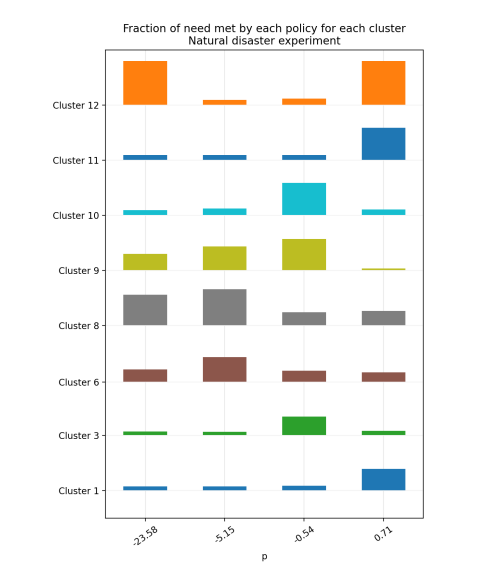
When a reinforcement learning policy affects many stakeholders, how should their outcomes be combined? Generalized p-means span a family of social welfare functions, from egalitarian to Nash to utilitarian, but the optimal policy can change dramatically with p. Rather than forcing decision-makers to choose a single p up front, we compute a small portfolio of policies that is approximately optimal for every p, with guarantees on the trade-off between approximation quality, portfolio size, and computation. The figure shows how different policies in a portfolio meet the needs of different clusters in a natural disaster experiment (a subset of clusters shown).
The implications of state aggregation in deteriorating Markov Decision Processes with optimal threshold policies
M. Pollack and L. N. Steimle. See paper
Markov Decision Process modelers often aggregate states into “superstates” so there is enough data to estimate transition probabilities. Coarser models are better estimated but less precise. We give conditions under which an aggregated MDP preserves an optimal threshold policy. In simulations, finer state spaces offer the most room for policy improvement, while aggregated models are preferable when data is limited.
When Should AI Defer? Responsible Automation for Deceased Donor Kidney Allocation
M. Pollack, T. Daillak, M. Toner, K. Uygun, H. Yeh, and S. Gupta.
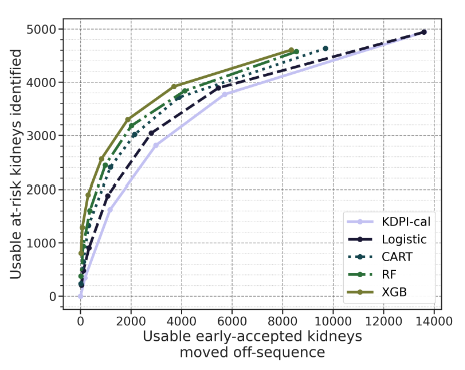
AI tools could help speed up the deceased donor kidney offer process, but in a setting this high-stakes, automation needs to know its limits. We study when an AI system should act and when it should defer to human decision-makers, building interpretable, uncertainty-aware models for responsible automation in kidney allocation. The figure shows the trade-off for several models: how many usable at-risk kidneys each identifies versus how many usable early-accepted kidneys it would move off-sequence.
Cost-Averse Learning with Mixed-Fidelity Bandit Feedback
M. Pollack, S. Gupta, and D. Martinez Duvall.
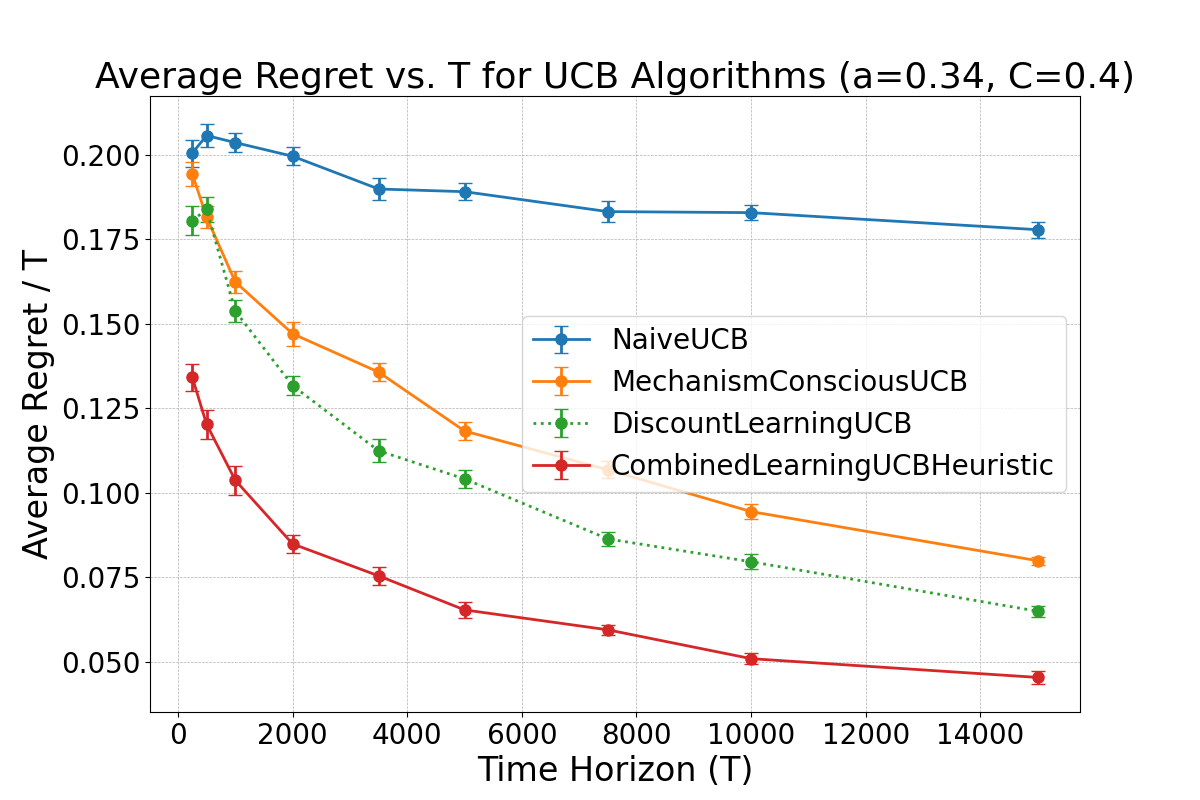
Learning often comes with a choice: rely on cheap, noisy feedback, or pay for more accurate information. We study bandit problems with mixed-fidelity feedback, where higher-quality observations carry a cost, and design UCB-style algorithms that learn when the extra information is worth paying for. In simulations, our combined learning approach substantially reduces regret compared to naive and single-mechanism baselines.